












MaSTR™ Evaluated for Mixed Canine DNA in Forensic Science International: Genetics

Probabilistic Genotyping (PG) has transformed the way human forensic laboratories handle complex DNA mixtures. Now, a peer-reviewed study published in Forensic Science International: Genetics marks a pivotal moment for the field of wildlife forensics: the first-ever evaluation of PG software for interpreting non-human DNA mixtures, with MaSTR™ as the tool that made it possible.
Can Probabilistic Genotyping Work Beyond Human DNA?
Forensic casework involving animals presents unique challenges. Crime scenes for wildlife trafficking or animal fighting cases, where biological material from countless animals is present, can yield complex mixed DNA profiles, just as in human cases. While probabilistic genotyping has become standard practice in many human forensic labs, wildlife forensic laboratories have lagged.
Two key hurdles have held the field back: the need for species-specific validations for each STR panel in use, and the complexity of sourcing appropriate population data for statistical analysis.
This new study by Samantha Badgett and colleagues at North Carolina State University sets out to address those barriers head-on.
MaSTR™ Handle Even the Toughest Canine Mixtures?
Researchers prepared artificial two- and three-individual mixtures of domestic dog DNA at varied mixture ratios and genotyped them using the DogFiler STR panel, a published, forensically validated 16-marker canine profiling system developed to meet SWGDAM recommendations and accepted in courts across the U.S.
The mixtures were designed to stress-test the software across a range of realistic and challenging conditions:
-
Unrelated two-individual mixtures (n = 12) and three-individual mixtures (n = 3), spanning a range of allele-sharing levels
-
Related individuals, a mother and a pair of offspring, representing some of the most difficult cases due to high allele sharing
-
Varying mixture ratios to assess performance across different contributor ratios
For each mixture, MaSTR™ was provided with true contributor single-source profiles under varying propositions, and the resulting likelihood ratios (LRs) were evaluated. A subset of unrelated mixtures was also analyzed with true non-contributors to assess false inclusion rates.
How Did MaSTR™ Perform on Canine Mixtures?
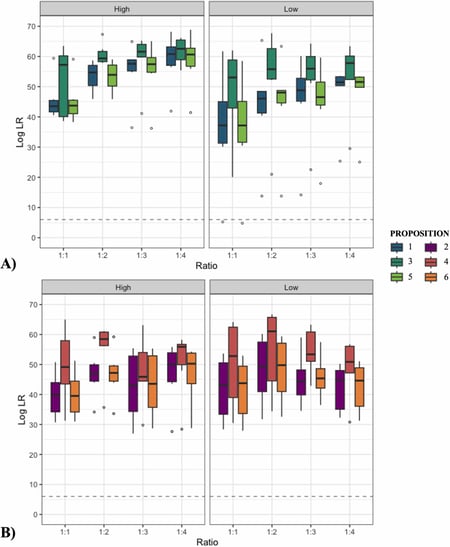 LogLR values for two-individual canine mixtures across mixture ratios and propositions under high and low allele-sharing conditions. A) major as reference only (proposition 1), major as reference and minor as known (proposition 3), and major as reference and minor as alternate (proposition 5); and B) minor as reference only (proposition 2), minor as reference and major as known (proposition 4), and minor as reference and major as alternate (proposition 6). Only true contributors were assigned a profile type. Values above the dashed horizontal line (LogLR of 6) are interpreted as very strong support for inclusion. Reproduced from Badgett SL, Tiedge TM, Parker TB, Love KR, Flack NK, Meiklejohn KA., FSI:G, 2026;83. CC BY 4.0.
The performance of MaSTR™ in this novel application was impressive:
-
Replicate precision: Coefficient of variation in the LogLR was just 1.83% for two-individual mixtures and 2.42% for three-individual mixtures, demonstrating strong reproducibility across replicate analyses.
-
False exclusion rate: Only 0.43% of true contributors were incorrectly excluded (LogLR < 6).
-
False inclusion rate: Zero. No true non-contributors were incorrectly included (LogLR > 6).
-
Challenging allele sharing was no obstacle: Despite nearly half of the mixtures involving individuals with high levels of allele sharing, MaSTR™ consistently returned the expected inclusion or exclusion result regardless of mixture ratio.
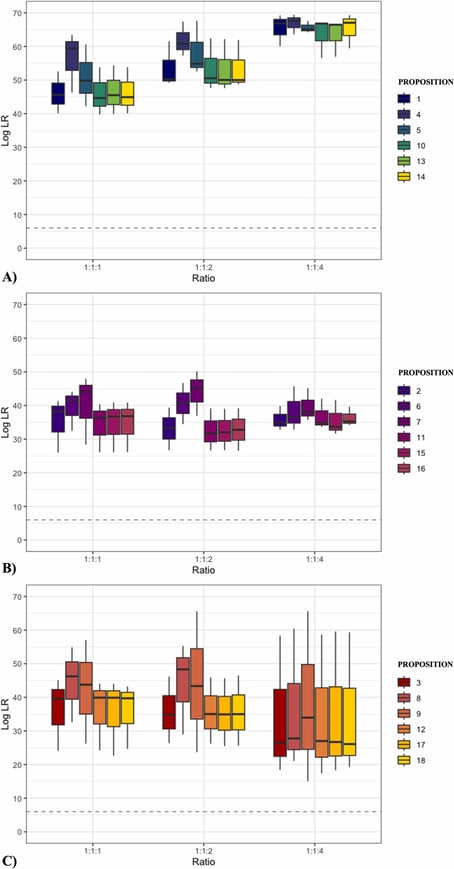
Log LR values for three-individual canine mixtures broken down by proposition grouping across mixture ratios. A) Major as reference, B) Minor 1 as reference, and C) Minor 2 as reference. Only true contributors were assigned a profile type. Values above the dashed horizontal line (LogLR of 6) are interpreted as very strong support for inclusion. Reproduced from Badgett SL, Tiedge TM, Parker TB, Love KR, Flack NK, Meiklejohn KA., FSI:G, 2026;83. CC BY 4.0.
These results speak directly to MaSTR™'s underlying architecture: a fully continuous probabilistic genotyping approach using Markov Chain Monte Carlo (MCMC) methods that models stutter, allelic drop-in and drop-out, and peak height variation, capabilities that translate from human to non-human applications.
Improving Wildlife Probabilistic Genotyping
The implications of this study extend well beyond a single validation experiment. Animal DNA evidence appears in a wide range of casework, from dog bite prosecutions to wildlife trafficking, poaching investigations, and dog fighting rings. Until now, analysts facing these situations had no validated computational tool to turn to.
This study demonstrates that MaSTR™'s flexible, model-based framework can be adapted for non-human STR panels, opening the door to more rigorous, defensible interpretation of animal DNA evidence in forensic casework worldwide.
As the authors note, laboratories interested in implementing PG for wildlife cases will still need to complete their own validations and, ideally, incorporate adjudicated case samples in that process. But this study provides a critical proof of concept and a practical roadmap for doing so.
MaSTR™: Built for Flexibility
MaSTR™ is a probabilistic mixture analysis software designed for research, validation, and casework applications. It features a rapid and transparent approach to probabilistic mixture analysis that leverages forensic acumen in an easy-to-use Windows® environment. Its server-based architecture is cost-effective and supports automatic queuing of multiple analyses, making it practical for busy forensic laboratories of all sizes.
This flexibility is precisely what enabled its application to canine STR mixtures in this study. MaSTR™'s ability to build custom models for non-human STR panels, combined with its compatibility with standard genotyping platform outputs, makes it uniquely suited to support the expanding frontier of forensic DNA analysis, whether in a human identification lab or a wildlife forensics unit.
This study adds to a growing body of peer-reviewed literature validating MaSTR™ across diverse contexts: two- to five-person human mixtures, differentially degraded DNA, low-template samples, and now, for the first time, non-human species.
Reference: Badgett SL, Tiedge TM, Parker TB, Love KR, Flack NK, Meiklejohn KA. Probabilistic genotyping of non-human DNA mixtures: Using MaSTR™ to analyze mixed canine STRs genotyped with DogFiler. Forensic Science International: Genetics. 2026;83. https://www.fsigenetics.com/article/S1872-4973(26)00017-7/fulltext
Get Started with SoftGenetics
Sign up to start your free 35-day trial! No credit card, no commitment required.
Start your free 35-day trial now.